How Founders Can Avoid Trademark Conflicts Before Launching Internationally
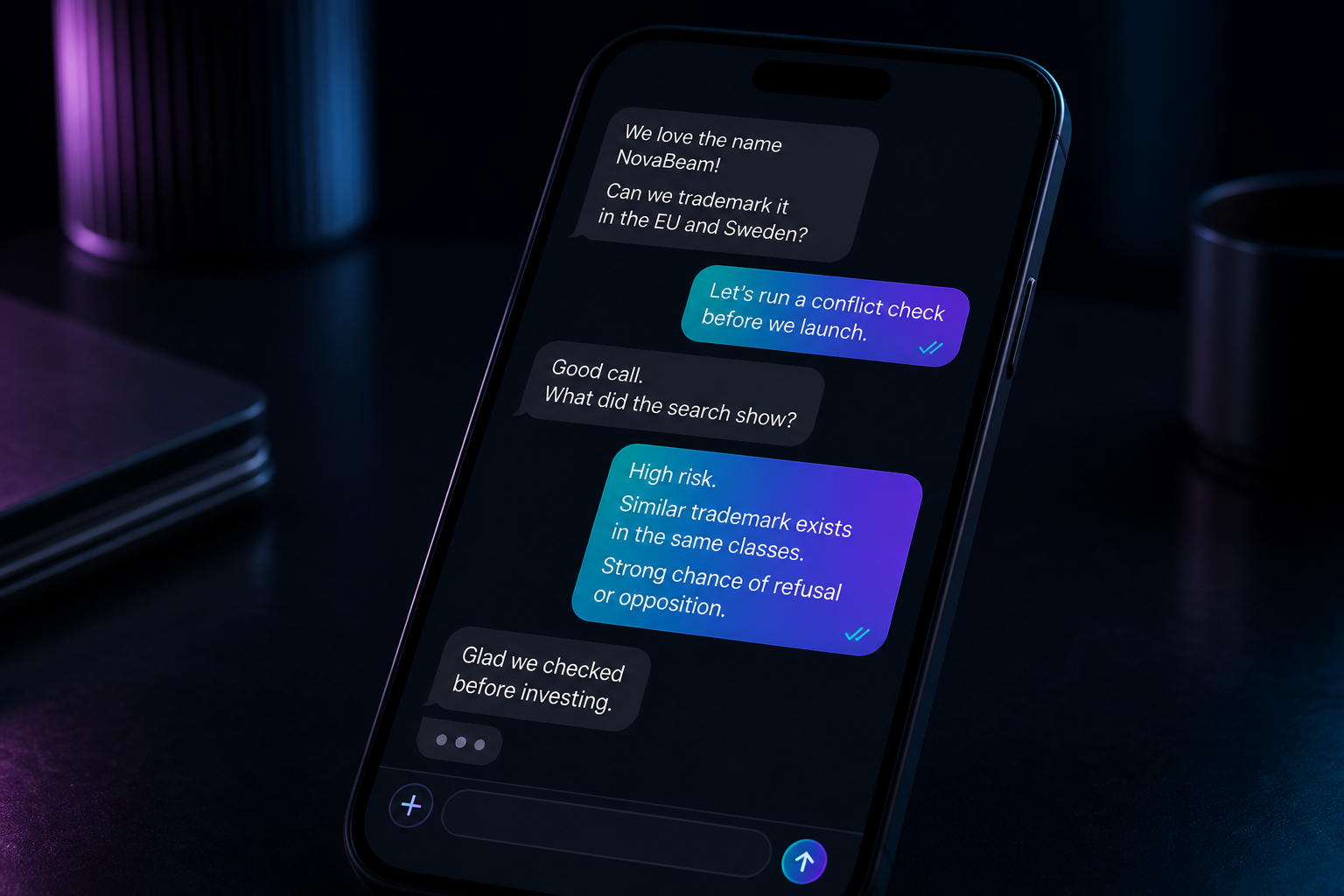
A bad name choice can delay launch, waste brand spend, and force a rebrand
One of the most expensive mistakes a founder can make is choosing a brand name too quickly, investing in design and launch assets, and only then discovering an earlier trademark, marketplace presence, or app listing that can block the rollout.
That problem can show up in several ways. A trademark application may be refused. An earlier rights holder may oppose your filing. A marketplace or platform may remove listings. Your app may run into naming issues in the App Store or Google Play. Someone may threaten to sue you. Or you may simply decide the risk is too high and rebrand after spending money on domains, packaging, ads, and customer acquisition.
The practical question is not just, “Do we like this name?” It is, “Can we realistically use and protect this name in the markets and channels that matter?”
This article explains how founders can reduce trademark conflict risk before launching internationally.
Trademark conflicts often happen because names are similar enough, not because they are identical
Many founders assume a conflict only exists if two brands are exactly the same. That is not how trademark risk usually works.
In plain English, the legal question is often whether customers could think two brands come from the same business, or from connected businesses. That means risk can arise when names look similar, sound similar, or mean similar things, especially if the goods or services are identical, related, or likely to overlap in the market.
For example, changing one letter, adding a suffix, or splitting one word into two words may still leave you too close to an earlier mark if the overall commercial impression remains similar. And a general legal principle is that, the closer the names, the further away the products/services need to be, and vice versa.
This matters even more because trademark ownership rules vary by country. Many markets are effectively first-to-file, while some give more weight to earlier use. If you want background on that distinction, see Abrande’s article on first-to-file vs first-to-use trademark systems.
The business consequence is simple: if you wait too long to check risk, you may spend real money building a name you cannot safely keep.
Founders should clear a shortlist before buying domains, building packaging, or briefing designers
The best time to test a name is when changing it is still cheap.
That usually means checking a shortlist of names before you commit to:
logo design;
product packaging;
website build;
domain purchases;
social handle rollouts;
marketplace onboarding;
App Store or Google Play submissions;
press, PR, or launch campaigns.
If you only search after these steps, the trademark issue becomes a business problem rather than a naming problem.
Start with distinctive names if you want fewer conflicts and stronger ownership
The easiest conflict to avoid is the one you never create.
Names that directly describe what you sell are often harder (and most often, impossible) to register and harder to defend. If consumers are likely to see the name as a product description rather than as a brand, the trademark may be weak or even rejected.
As a rule of thumb, ask yourself:
Does the name simply describe the product, service, quality, or market?
Would competitors reasonably want to use similar wording?
Does the name feel crowded before we have even launched?
Invented words, unusual combinations, or names with a more distinctive character are often easier to clear and more valuable over time.
Example: a startup selling accounting software may face more difficulty with a name like “Smart Bookkeeping” than with a distinctive coined name that does not directly describe the service.
If you want a deeper explanation of that issue, Abrande’s article on why trademark distinctiveness matters is a useful companion piece.
Start with official trademark databases, then expand to real-world market checks
A sensible founder-level review should start with official trademark registers and then move outward.
Useful starting points include:
Abrande’s free trademark clearance search tool for an early global screen;
WIPO Global Brand Database for international trademark records;
Madrid Monitor for international registrations under the Madrid System;
USPTO trademark search for the United States;
TMview for many participating national and regional offices;
EUIPO trademark search tools for EU rights;
UK IPO trademark search for UK rights.
But official databases are only part of the picture. You should also search where customers actually discover and buy products.
That means checking:
Google and other search engines for unregistered market use;
major marketplaces relevant to your category, such as Amazon, Etsy, eBay, Alibaba, or regional platforms;
the Apple App Store and Google Play if you have an app or app-like digital product;
domain availability and obvious domain variants;
company-name records in relevant markets;
major social platforms and creator channels where the brand may already be in use.
This wider review can reveal brands that may not immediately appear in your first trademark search but still create commercial, platform, or enforcement risk.
Important note: Do not treat domain availability as a green light. A free domain may only mean nobody registered that exact web address. It does not mean the name is safe from trademark conflict. Abrande also covers that point in its article on why company names, domains, and trademarks are not the same thing.
Exact-match searches are not enough because risk also sits in sound, meaning, and variation
This is where many internal name reviews go wrong.
Founders often search only the exact spelling they want to use. But conflicts can arise from similar variants.
When reviewing a name, search for:
phonetic equivalents;
singular and plural forms;
hyphenated and combined versions;
common misspellings;
translations or words with similar meaning;
shortened forms and obvious abbreviations.
This same logic should carry into Google searches, marketplace searches, and app-store searches. If users are likely to confuse the names in spoken or typed form, the risk does not disappear just because the exact spelling differs.
Ask yourself: if you heard the two names on a podcast, over the phone, or in a sales meeting, would you think they might refer to the same company? If the answer is “possibly,” the name deserves a closer review.
Trademark classes matter, but the real question is commercial overlap
Trademark applications are filed for specific goods and services, grouped into categories called trademark classes (Nice classes, in legalese). In plain English, classes are filing buckets that describe what the brand is used for.
But class numbers alone do not decide risk.
The more important question is whether the earlier brand and your brand are close enough in the market that customers may assume a connection.
Ask these questions:
What goods or services does the earlier mark cover?
Are we selling something identical, complementary, or adjacent?
Would a buyer expect both offers to come from the same business?
Are we likely to expand into those categories within the next 12 to 24 months?
Example: a software company may begin with a niche B2B tool, then later expand into training, analytics, a marketplace, or a mobile app. A name that looked acceptable in one narrow category may become more exposed as the business broadens.
This is why filing too narrowly can be a problem, and filing too broadly without a plan can also create issues. The filing strategy should reflect how the business will actually grow.
If you plan to launch internationally, your clearance review should reflect that from day one
A common founder mistake is checking only the home market because that is where the company starts.
That can be too narrow.
A name that looks available locally may become problematic if your product roadmap, fundraising plan, distributor strategy, or e-commerce setup assumes expansion into the United States, the EU, the UK, Asia, or other target markets.
In commercial terms, your trademark review should match your market-entry plan.
If your roadmap includes cross-border sales, marketplace expansion, app distribution, or international paid acquisition, search and filing decisions should reflect that before launch, not after traction appears.
Check language, translation, and local meaning before you commit
International launches create another issue that founders often underestimate: a name may be legally available but commercially awkward in another language or region.
Before you commit, ask:
Does the word have an unwanted meaning or negative associations in a priority market?
Is the pronunciation difficult or misleading in another language?
Does the name resemble a known local competitor, slang term, or descriptive term?
Will users shorten it into something riskier?
This is not always a trademark issue in the narrow legal sense, but it can still create confusion, weak adoption, or platform friction in new markets.
Check word marks and visual branding separately
Founders sometimes clear the name and assume the branding is done. Not quite.
The word mark and the logo can create different risk profiles. A word may be usable, while a visual identity creates separate issues because it resembles another brand’s stylisation, icon, or layout.
Ask yourself:
If we removed the words, would the logo still look uncomfortably close to a competitor?
Are we using a symbol, badge, or packaging style that is common in the category?
Could the overall visual impression suggest a commercial link?
This is especially relevant in consumer products, fashion, beauty, apps, and D2C brands, where visual similarity can matter just as much as the name itself.
A simple founder checklist can reduce risk before the name goes to legal or outside counsel
If you want a practical workflow, use this:
Create a shortlist of 3 to 5 names.
Remove names that are highly descriptive or generic.
Run an early screen in Abrande’s clearance tool.
Check official trademark databases in your current and planned markets.
Search for similar spellings, pronunciations, and meanings.
Search Google for live market use and unregistered competitors.
Check major marketplaces relevant to your product category.
Check the Apple App Store and Google Play where relevant.
Review domain, company-name, and social-platform signals.
Map the goods and services you sell now and may sell next.
Review the logo and other visual elements separately.
Escalate the best candidate for deeper clearance before filing or launch.
This process will not eliminate all risk, but it often improves decision quality materially.
Some situations justify a deeper professional clearance review before you file or launch
A founder can do a useful first-pass search internally. But some situations warrant a more detailed legal review.
That is usually worth considering when:
the name will be central to the company’s valuation;
the launch budget is meaningful;
searches reveal several similar marks in related areas;
you plan to expand internationally soon;
distributors, investors, or partners are asking about ownership risk;
a rebrand after launch would be commercially painful.
A deeper review does more than count search results. It helps assess how risky the similarities are in context, whether the filing scope makes sense, and where the real pressure points sit.
That can save time on the back end by reducing refusals, oppositions, takedowns, and avoidable rebranding costs.
Common founder mistakes that trigger trademark conflict are usually preventable
Choosing a name because the domain is available.
Searching only exact matches.
Ignoring planned expansion markets.
Skipping Google, marketplace, or app-store checks.
Picking classes without linking them to the business plan.
Investing in branding before clearance is finished.
Assuming a small spelling change makes the name safe.
Forgetting that logos and packaging can create separate issues.
Most of these mistakes happen because the team treats trademark review as an admin task. In reality, it is an early-stage brand decision with legal, financial, and go-to-market consequences.
The cheapest time to solve a trademark problem is before launch
If you are building a brand with international ambition, a sensible name review is usually a low-cost way to avoid a much more expensive cleanup later.
The practical goal is not absolute certainty. Trademark outcomes always depend on facts, markets, channels, and the rights already on file. The goal is to reduce avoidable risk before design spend, launch timing, and market credibility are on the line.
For most founders, the right question is simple: can we build around this name with a reasonable level of confidence where we plan to operate next?
If the answer is unclear, it is better to find that out now than after the packaging is printed or the app is live.
Disclaimer: This article is for informational purposes only and does not constitute legal advice. If you want help reviewing a name, shaping a filing strategy, or reducing conflict risk before launch, Abrande can support with trademark clearance and filing strategy across international markets.